Auditeurs:
Meilleurs auditeurs :
-
play_arrow
Radio Funk : Webradio Disco, Funk, Soul and Boogie 80
-
 play_arrow
Radio Funk Live Radio Funk


theDAW is an all‑in‑one AI music studio that lets you create, edit, mix, DJ, and run live visuals from a single brain—perfect territory for any funk, disco, or underground soul head who wants to ride the next wave without betraying the groove.
From Salsoul to Silicon: theDAW and the New Age of the AI DJ
theDAW is an all‑in‑one AI DAW built by GANTASMO, combining generative audio, full‑fat studio tools, DJ performance, and live visuals in a single environment.
It takes your text prompts, your samples, and your stems, then blends them with a custom Chimera engine that analyzes, beat‑aligns, and mutates multiple source clips into fresh audio—live, in sync, and under your fingers.
GANTASMO themselves come from the frontline of AI music and XR performance, with shows at CES, the AI Song Contest, and experimental AI music meetups, so theDAW is born on stage, not in a spreadsheet.
If you love Salsoul, West End, Prelude, Philadelphia International or Casablanca, think of this as the 12‑inch revolution all over again—only this time the pressing plant is made of GPUs and neural nets.
Welcome to the Neon Afterlife of the DJ
Oh yeah… pull up a chair, my friend.
You hear that low synth pad, those ghostly claps under a four‑on‑the‑floor?
That’s not just another loop pack. That’s AI music breathing down the neck of every lazy DJ who thought a pre‑made playlist was enough to survive the next decade.
Today we’re talking about theDAW, an all‑in‑one AI DAW built by GANTASMO, a duo who’ve been warping reality with neural networks, XR visuals, and live AI‑driven performances from Las Vegas to CES and the AI Song Contest.
This isn’t a toy or a “beta coming soon” brochure—it’s a working environment where you can write tracks with text prompts, remix live, cut visuals, and perform like a mad scientist in a sequined blazer.
But before you panic: no, AI isn’t here to erase the soul of disco, funk, and underground soul.
It’s just another machine—like the LinnDrum, like the SP‑1200, like the first DJ who dared to extend the break. What matters is who drives it and what records live in their heart.
So let’s take a deep dive into how theDAW works, why it matters for AI DJs, and how you, a vinyl‑sniffing lover of rare grooves, can use this beast without sacrificing the sacred legacy of Salsoul, Philadelphia International, West End, Prelude, Casablanca, T.K. Disco and the whole family tree that built our dance floors.

Table of Contents
From Loft Parties to Neural Nets
The Original AI: Human DJs in Dark Rooms
Before anyone whispered “AI DJ” into a venture‑capital mic, the algorithm was a human behind two turntables in a room that didn’t even have a sign on the door. At places like The Loft and underground New York parties in the early 1970s, DJs stitched together funk, soul, Latin, and odd imports into proto‑disco marathons long before the word “disco” was even stamped on a 12‑inch.
Those selectors weren’t just playing records. They were training the crowd—testing unknown B‑sides, stretching breaks, riding the EQ like a synth. Labels followed. Philadelphia International Records, powered by Gamble & Huff and the orchestra MFSB, codified the lush, orchestrated Philly soul sound that evolved into early disco, all strings and brass over a solid four‑on‑the‑floor. Salsoul fused Latin and soul with an in‑house orchestra, and helped push the 12‑inch single from DJ promo into commercial reality.
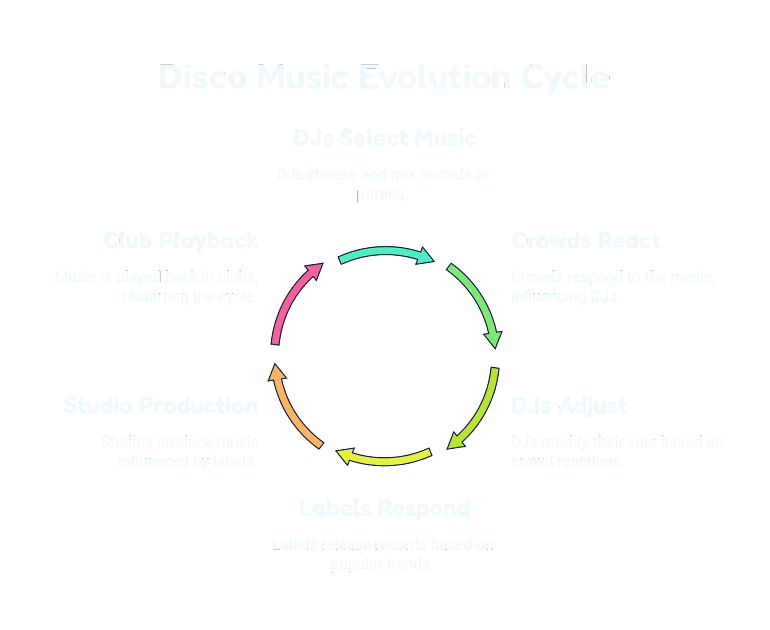
In other words, long before machine learning, clubs already were training data sets. Crowds reacted; DJs adjusted; labels responded. The loop—club → label → studio → club—was the original feedback system that shaped everything from West End’s downtown grooves to Prelude’s sleek early‑80s boogie.
Labels That Engineered the Groove
Let’s name names, because these labels are the grandparents of every modern AI music engine that claims to “learn” groove.
-
Philadelphia International Records (PIR) in Philly gave us symphonic, socially conscious soul that slid gracefully into disco, with artists like MFSB and Teddy Pendergrass.
-
Salsoul Records in New York brought the Salsoul Orchestra, Double Exposure, Loleatta Holloway, and pushed the first commercially available 12‑inch, smashing open a whole new format for DJs.
-
West End Records linked tight to the Paradise Garage, with tracks like “Heartbeat” and “Is It All Over My Face” defining that late‑70s New York club pulse.
-
Prelude Records bridged disco to boogie, leaning into synths and early drum machines while still dripping with funk—think D‑Train and Sharon Redd.
-
Casablanca and T.K. Disco shaped everything from Florida‑flavored disco to big‑room anthems, feeding DJs an endless stream of club‑focused releases.
These labels didn’t just document a scene; they engineered it—dialing in arrangements, pressing extended mixes, and working hand‑in‑hand with DJs to test what worked on real dance floors. If you squint a bit, every serious AI DAW today is trying to do a digital version of that: capture feedback, refine the mix, and keep the floor moving.

What Exactly Is theDAW?
The Generative Engine and Chimera
Time to lift the hood.
theDAW, built by GANTASMO, is described as an all‑in‑one application for music creationwhere a generative engine renders audio from multiple kinds of input. You can feed it:
-
An init audio source (your voice, a vinyl rip, any imported file, a clip from the library or media bucket).
-
A pattern from the piano roll or step sequencer.
-
A text prompt describing the sound or vibe you want.
-
A painted inpaint region, where you literally carve out part of the waveform or timeline to be regenerated.
On top of that, theDAW comes with a Chimera engine that analyzes, blends, and beat‑aligns several source clips into a single generation, rendered live as what they call the CRISPR splice scene.
Think of it as a hyper‑intelligent multi‑track editor that can fuse your Philly string loop, a Salsoul‑style conga section, and a synthetic bass line you described with text—then spit out something new that still respects tempo and groove.

This isn’t just style‑transfer wallpaper. Chimera is designed to look at multiple clips, understand their timing, and create a fresh hybrid in real time, like an AI‑powered version of tape splicing and remix culture. That’s exactly the kind of tool you want if you’re trying to bring disco, funk, and soul into an AI‑driven future without flattening them into generic background tracks.
From Studio to Live Rig
The workspace in theDAW opens up into a full studio for composition, arrangement, editing, and mixing, but it doesn’t stop there. It also morphs into a live rig for DJing and VJing, with deep MIDI mapping for whatever controller you love.
You’re not trapped in a traditional “DAW window.” Instead, theDAW is built to be:
-
A composer’s room: arrange, edit, and mix AI‑generated or human‑recorded audio.
-
A DJ booth: trigger clips, splice Chimera scenes, and run transitions live.
-
A VJ cockpit: drive real‑time visualizers that react to the music, plus an interactive genealogy graph that shows the relationships between your generated clips.
That genealogy graph is more than eye candy. It lets you see how ideas evolved—what clips came from which prompts and which mixes—like a digital family tree of your session.
For a radio programmer or DJ, that’s gold.
You can trace a magical moment in a set back to the exact combination of sources and prompts that birthed it.

Key theDAW Features at a Glance
Here’s a simple overview you can keep in your back pocket.
This is why I call theDAW a “stage‑born DAW”—it clearly wants to be played, not just clicked.
Playing theDAW Like a Disco‑Soul Instrument
Sampling the Past, Aiming at the Future
Here’s the secret: if you walk into theDAW empty‑handed, you’ll sound like everyone else. But if you walk in with decades of disco and funk in your veins, it becomes an instrument.
Imagine this workflow:
-
You drop a vinyl rip of a Salsoul conga break, a snippet of a Philly string intro, and a clean kick‑only loop from a T.K. Disco 12‑inch as your init audio sources.
-
You sketch a bass pattern in the step sequencer inspired by D‑Train or Sharon Redd, all those Prelude‑style syncopations, then feed it into the generative engine.
-
You type a text prompt like: “late‑night loft groove, warm analog strings, punchy funk bass, hypnotic hi‑hats, 112 BPM, New York 1979 meets 2040.”
Now you let the Chimera engine chew through those inputs, generating a hybrid groove that respects tempo and rhythmic feel while mutating the texture. Instead of just looping the same eight bars, you’re exploring alternate realities of your favorite records.
You can then paint inpaint regions over parts of the track—maybe the breakdown feels weak—tell the system to redraw just that section, and keep regenerating until the drop hits like a Paradise Garage moment in a neon metaverse.

AI DJ Sets Without Losing the Crowd
An AI DJ set doesn’t mean you hit “auto‑mix” and go have a drink. That’s the lazy dystopia everybody fears. In a theDAW world, a smart AI DJ is doing things that would be nearly impossible in a purely analog booth.
For example, you could:
-
Start with a classic West End or Salsoul‑inspired loop as a base, then live‑generate alternate versions of the same groove on the fly using Chimera, morphing textures while keeping BPM and structure stable.
-
Use the genealogy graph to jump between “generations” of a track—like traveling up and down a remix family tree—to respond to the crowd’s energy.
-
Trigger visual scenes that match each evolution of the track, so the audience doesn’t just hear your transitions; they see the story unfold.
The trick is to stay present. You’re still reading the room (or the chat window if you’re streaming), still EQing, still deciding when to strip things down and when to go full cosmic disco. The AI just gives you more clay to sculpt with, faster.
When people say, “AI will kill DJs,” they’re talking about the ones who were dead creatively anyway. The rest of us? We’re just upgrading our weapons.

GANTASMO: From Experimental AI to Club‑Ready Tools
AI Music Meets XR Performance
theDAW doesn’t come out of nowhere. It’s built by GANTASMO, an AI music and XR performance project founded by Daniel Joaquín Trujillo (and collaborators) that’s been active since around 2018–2019. GANTASMO have performed AI‑infused shows at CES for SwissTech, been finalists in the AI Song Contest, and taken part in AI music meetups and hackathons focused on XR and immersive experiences.
Their work combines neural composition, immersive technology, and live performance, using AI to morph melodies and textures in real time while driving reactive visuals and AR/VR environments. That means they’re not theorizing about AI music from a distance; they’re sweating under stage lights, debugging neural nets at soundcheck, and learning what actually plays in front of a live crowd.
This matters. A lot of AI music tools feel like they were designed by people who haven’t seen a packed dance floor since MySpace.
GANTASMO’s background—bridging XR, performance art, and club culture—makes theDAW feel less like a boardroom demo and more like a weapon you’d bring to a warehouse party.

Why theDAW Feels Stage‑Born, Not Lab‑Built
Take a look at the design priorities:
-
Live rig mode isn’t an afterthought; it’s built into the core concept, with VJing and DJing sitting alongside composition and mixing.
-
The Chimera/CRISPR splice system is clearly performance‑oriented, letting you blend and mutate multiple clips live instead of freezing creative decisions in the studio.
-
The environment is geared toward real‑time visualizers and interactive structures like the genealogy graph, which feel straight out of GANTASMO’s own XR performances.
If you’re a DJ or radio curator used to juggling Ableton, Serato/Rekordbox, plus a separate VJ tool, the idea of a single AI DAW that spans music, DJing, and visuals starts to sound very attractive. theDAW isn’t trying to replace your taste; it’s trying to compress your whole rig into a more fluid, more generative system.
Contemporary Artists Carrying the Torch
Neo‑Disco, Nu‑Boogie, and AI‑Driven Hybrids
We’re living through a strange era where AI music and retro‑obsessed revival scenes are happening at the same time. On one side, you have tools like theDAW, browser‑based AI audio workstations like StableDAW for text‑to‑audio and advanced editing, and AI‑driven visual platforms. On the other, you’ve got a whole ecosystem of artists drawing directly from 70s/80s disco, boogie, and funk, re‑cutting those ideas for today’s dance floors.
The smartest contemporary producers don’t see a conflict. They treat AI like:
-
A super‑sampler that can interpolate between styles and sounds.
-
A sound‑design assistant that generates textures for them to reshape.
-
A sketchpad for quickly testing arrangements before bringing in live musicians or analog gear.
If you’re a fan of tight rhythm sections, horn stabs, and that bittersweet disco melancholy, the future isn’t about replacing those feelings. It’s about using AI DAWs like theDAW to unlock new combinations, new bridges between eras, new “what if…?” scenarios that would have taken days to mock up in a traditional DAW.
In the right hands, an AI engine can function like a reincarnated studio band—disciplined, responsive, and ready at 4 a.m. when inspiration strikes.

Mixcloud, Radio, and the New Listening Ritual
This is where platforms like Mixcloud and dedicated stations like radiofunk.radio come in. You and I both know: half the magic of disco and funk happens in the mix—how tracks talk to each other, how a DJ strings together an emotional arc across 60 or 90 minutes.
With tools like theDAW, DJs and curators can:
-
Build AI‑assisted edits and alternate versions of classic‑inspired grooves, then fold them into mixes alongside original vinyl cuts.
-
Craft themed shows—“AI Salsoul Dreams,” “Future Philly Strings,” “Boogie from Another Timeline”—where some tracks are classic, some are new, and some are AI‑deformed hybrids.
-
Record live sets that include real‑time Chimera blends and visual performances, then archive them on Mixcloud for people to re‑live later.
The ritual doesn’t go away. You’re still putting on headphones, still cueing up the show, still nodding along in your kitchen or car. The only difference is that the line between “producer,” “DJ,” and “VJ” melts a little—and an AI DAW like theDAW makes that fusion feel natural rather than gimmicky.
FAQ: Your Burning AI DJ Questions
Is theDAW only for AI freaks, or can a “normal” DJ use it?
No gatekeeping here. If you can navigate a basic DAW and understand how loops, clips, and MIDI mapping work, you can grow into theDAW. You don’t have to use every AI feature on day one; you can start by treating it like a performance‑oriented DAW with strong visualizers, then gradually bring in generative tools as you get comfortable.
Will AI DAWs kill human DJs and producers?
They’ll expose the lazy ones. But the DJs and producers who know their history—who understand why Salsoul pressed extended 12‑inches or why West End worked so closely with clubs like Paradise Garage—will simply have more tools to express themselves. AI is not a replacement for taste, selection, timing, or emotional intelligence.
Can I still use my vinyl and hardware with theDAW?
Yes. theDAW can work with init audio from any source, including recorded vinyl rips and hardware synth jams. You can sample, chop, and feed those into the generative engine or Chimera system, creating hybrids that still carry the fingerprint of your original gear and records.
What about visuals—do I need to be a VJ?
Not at all. theDAW includes audio‑reactive visualizers and a performance rig that can drive visuals without requiring you to code or design from scratch. If you want to go deeper, you can always pair it with dedicated AI‑visual platforms, but out of the box it’s already a solid step into the VJ world.
Is theDAW more studio‑focused or live‑focused?
Both. The environment opens into a full studio for composition and mixing, and also into a live rig for DJing and VJing with deep MIDI mapping for your controllers. That dual nature is exactly what makes it attractive for DJs, radio programmers, and live streamers who don’t want to juggle five different apps anymore.

Recommended Discography
If you want to train your ears (and your AI tools) on the right DNA, start here. These aren’t random classics—they’re reference points for anyone building a future‑facing AI DJ setup grounded in real musical history.
Foundational Disco & Soul
-
MFSB – Love Is the Message (Philadelphia International Records)
-
The O’Jays – Ship Ahoy (PIR)
-
Teddy Pendergrass – Life Is a Song Worth Singing (PIR)
-
Salsoul Orchestra – Salsoul Orchestra (Salsoul)
-
Loleatta Holloway – key 12‑inches on Salsoul
12‑Inch Culture & Remix DNA
-
Double Exposure – “Ten Percent” (Salsoul, one of the first commercially released 12‑inch singles).
-
First Choice – “Let No Man Put Asunder” (Salsoul)
-
Taana Gardner – “Heartbeat” (West End)
-
Loose Joints – “Is It All Over My Face” (West End)
-
Sharon Redd – “Beat the Street” (Prelude)
Boogie & Early Synth‑Driven Funk
-
D‑Train – You’re the One for Me (Prelude)
-
France Joli – selected 12‑inches on Prelude
-
Sylvester – Step II (Megatone/Casablanca era)
-
Patrick Cowley productions (for their early use of synth and drum machines in a club context).
Feed these records—legally sampled, respectfully chopped—into theDAW and see how the AI reacts. It’s like giving it a masterclass in groove.
Essential Playlists
Here are some playlist concepts you can build on radiofunk.radio, Mixcloud, or your own library, using a mix of original records, edits, and AI‑generated material from theDAW.
Playlist 1 – “AI in the Garage”
-
Early‑80s New York‑centric disco and boogie cuts.
-
theDAW‑generated extensions of classic‑inspired grooves.
-
Live Chimera blends that fuse vocal acapellas with newly generated instrumentals in the spirit of Paradise Garage.
Playlist 2 – “Future Philly Strings”
-
Philadelphia International and PIR‑inspired ballads and mid‑tempo grooves.
-
AI‑generated orchestrations built from string and horn samples fed into theDAW as init audio.
-
Modern neo‑soul cuts that echo the same lush arrangements and chord movements.
Playlist 3 – “Salsoul to Cybersoul”
-
Original Salsoul Orchestra, First Choice, Instant Funk, and related cuts.
-
theDAW‑generated hybrids that re‑imagine Latin‑disco percussion with futurist synth textures.
-
Contemporary nu‑disco tracks that feel like grandkids of the Salsoul sound.
Playlist 4 – “Boogie Beyond the Grid”
-
Prelude‑style boogie, heavy on synth bass and drum machines.
-
AI‑generated bass lines and chord stabs driven by step‑sequencer patterns in theDAW.
-
Modern electronic funk that blurs the line between live and generated performance.
Each playlist becomes a laboratory: you test what happens when AI music sits shoulder‑to‑shoulder with the real thing. When it holds up, you keep it. When it doesn’t, you delete it and try again. That’s DJing.
The Groove Is Still in Your Hands
Here’s the truth, my friend: AI DAWs like theDAW don’t spell the end of DJs, producers, or radio curators. They spell the end of passengers. theDAW is an all‑in‑one AI music environment built for people who want to drive—who want to take init audio, text prompts, sequenced patterns, and wild ideas, then wrestle them into something that hits like a club record and shimmers like an XR performance.
From Philadelphia International to Salsoul, from West End to Prelude, our culture has always been about technology meeting community—new formats, new mixers, new studios feeding Black, Latino, queer, and underground scenes that turned oppression into joy on the dance floor. Today, AI is just the latest machine in that lineage. What matters is that you bring your ears, your stories, your scars, and your impeccable taste to the session.
So here’s your call to action:
Fire up theDAW. Feed it your favorite grooves. Push it until it surprises you. Then come back to radiofunk.radio, drop those AI‑kissed cuts into your sets, and let the world hear what happens when old‑school funk, disco, and soul shake hands with the future.
The machines can generate.
Only you can make it mean something.
And above all… keep listening. Turn up radiofunk.radio and let’s write the next chapter together.
Articles similaires


Latest news
Now on air
Upcoming shows
Top Funk
-

1
play_arrowThe Life of the Party
-
2
play_arrowHoney Love
-
3
play_arrowI Can't Help It
-
4
play_arrow(You Were Made) Especially for Me
-
5
play_arrowDancing Machine
-