Auditeurs:
Meilleurs auditeurs :
-
play_arrow
Radio Funk : Webradio Disco, Funk, Soul and Boogie 80
-
 play_arrow
Radio Funk Live Radio Funk

A simple wah‑wah guitar riff, played by Charles “Skip” Pitts and imagined by Isaac Hayes, didn’t just soundtrack a movie; it rewired the relationship between funk, cinema and Black representation on screen. The “Theme from Shaft” turned a low‑budget crime film into a cultural earthquake, took Stax Records to the top of the charts, and made Hayes the first Black artist to win an Oscar in a non‑acting category. From 1970s blaxploitationsoundtracks to today’s retro‑soul and hip‑hop samples, that riff still echoes in our playlists, our clubs, and, of course, here on Radio Funk.
The Night New York Started Walking in Wah‑Wah
Oh yeah… pull up a chair, my friend.
Close your eyes for a second. Picture Times Square in 1971: dirty sidewalks, steam rising from the subway grates, yellow cabs ignoring anybody who looks remotely like you, neon flickering over grindhouse cinemas.
And then it hits: sixteenth‑note hi‑hat, crisp as a razor, slicing the air like footsteps in the snow.
A guitar slips in behind it, not clean, not polite, but dripping with wah‑wah, bending and clawing its way through the mix like it owns the block.
That riff is the first thing you really feel in Shaft, the 1971 film directed by Gordon Parks and starring Richard Roundtree as John Shaft, “the Black private dick that’s a sex machine to all the chicks,” as Hayes would later sing.
The movie was one of the first big hits of the blaxploitation era and helped pull MGM back from financial disaster, but the real secret weapon wasn’t just the trench coat or the attitude – it was the soundtrack.
With his double‑LP Shaft soundtrack for Stax’s Enterprise label, Isaac Hayes did something radical: he brought uncompromising funk and symphonic soul right into the heart of Hollywood, turned it into a chart‑topping album, and walked away with Grammys and an Oscar for Best Original Song.
The “Theme from Shaft” hit No. 1 on the Billboard Hot 100, the album topped the Billboard 200, and Hayes became the first African American to win an Oscar in a non‑acting category – and the first to both write and perform a winning song.
Today, we’re talking about how that one guitar riff didn’t just make a movie cool – it changed funk history, influenced the sound of disco 70s, and rewrote the rules for film music and Black representation on screen.
Table of Contents
-
Introduction – The Night New York Started Walking in Wah‑Wah
-
2. Birth of a Legendary Riff: Skip Pitts, Wah‑Wah, and the Streets of Harlem
-
4. From Soundtrack to Chart Monster: How Shaft Conquered Pop
-
5. From Blaxploitation to Hip‑Hop and Neo‑Funk: The Riff’s Long Shadow
-
Recommended Discography – Essential Isaac Hayes & Blaxploitation Funk
1. Before the Riff: Isaac Hayes, Stax and Cinematic Soul
From Bar‑Band Pianist to Symphonic Soul Architect
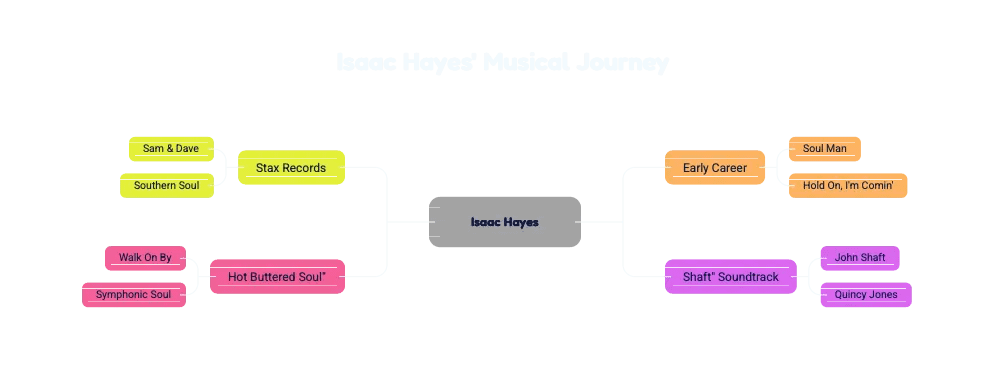
Before he ever dreamed of scoring Shaft, Isaac Hayes was already a quiet storm brewing inside Stax Records in Memphis. As a session musician, songwriter and producer, he co‑wrote hits like “Soul Man” and “Hold On, I’m Comin’” for Sam & Dave, helping shape the gritty Southern soul sound that defined Stax.
But Hayes was restless; he wanted longer forms, bigger orchestrations, songs that stretched like late‑night conversations and didn’t care about radio length.
That obsession gave us albums like “Hot Buttered Soul”, where he turned “Walk On By” into a 12‑minute cinematic drama and basically invented what people would later call “symphonic soul.”
Long intros, monologues, strings, horns, deep grooves – Hayes treated the studio like a movie screen, painting emotions with arrangements that were as visual as they were musical.
When MGM came looking for a fresh sound for their new detective film about a cool Black private eye in New York, Stax’s Al Bell pushed Hayes as the man for the job.
Hayes himself admitted he wasn’t sure about it at first and even consulted Quincy Jones before saying yes.
But once he saw the rushes, the images of John Shaft cutting through Manhattan, he was all in – and all his previous experiments with long grooves and lush orchestrations suddenly found their perfect playground.
Gordon Parks, Black Vision and a New Kind of Hero
There’s another name you can’t ignore in this story: Gordon Parks. Parks was already a legendary photographer and one of the first major Black directors to work within the Hollywood system when he signed on to direct Shaft.
He understood how crucial the music would be to the film’s identity; in behind‑the‑scenes footage, you can see him sitting with Hayes, explaining that Shaft is “relentless… always on the move” and that the music has to depict that.
Parks wanted a Black hero of James Bond stature – suave, dangerous, independent – but rooted in the realities of Black urban life. Hayes later said, “At last we have a Black hero of James Bond stature in John Shaft… ‘Shaft’ looks at things from a Black point of view, it tells it like it is.”
That point of view wasn’t just in the script or the camera angles; it was encoded in the very sound of the film – the funk, the grit, the swagger of that wah‑wah guitar and the deep, rolling bass.
Birth of a Legendary Riff: Skip Pitts, Wah‑Wah, and the Streets of Harlem
The Hi‑Hat That Started It All
Let’s go right to the heart of it: that guitar riff doesn’t appear alone. It steps into a groove that’s already in motion – a high‑hat pattern that sounds like a heartbeat doing double time.
Drummer Willie Hall laid down that sixteenth‑note hi‑hat figure, reportedly inspired by a break on Otis Redding’s “Try a Little Tenderness,” another Stax cut Hayes knew well.
It’s pure funkminimalism: just hi‑hat, but it creates tension, locomotion, a sense that Shaft has been walking these streets long before we joined him.
Over that, the bass creeps in, thick and rubbery, then the keys, then horns and strings – all of it building a cityscape in sound. But the first thing that really slices through your chest is the guitar, and that’s where Charles “Skip” Pitts comes in.
Skip Pitts and the Wah‑Wah Heard Around the World
Skip Pitts was already a seasoned soul and blues guitarist when he joined Hayes’ band, but it’s his wah‑wah work on the “Theme From Shaft” that made him immortal.
His riff – syncopated, dripping with attitude, climbing and falling like conversation in a Harlem bar – became one of the most recognizable guitar lines in the history of funk.
In interviews, Hayes explained how it came together: he asked the engineer to pull up a previously recorded guitar lick, then told Skip to play the same idea but “put a wah to it.”
Hayes literally got on his knees to move the pedal himself until the feel was right, and then Pitts took that concept and mastered the wah‑wah language that would define the track.
The result is a guitar that doesn’t just accompany the beat – it talks, it struts, it seems to side‑eye every cop, pimp and hustler Shaft passes in the opening scene.
That’s the magic: this riff is character development. Before Shaft even speaks, you already know he’s dangerous, stylish, and absolutely not to be messed with, because the guitar tells you so in plain funk.
Shaft, Blaxploitation and Funk on the Big Screen
What Blaxploitation Really Meant
By the early 70s, Hollywood was in trouble, and studios were desperate for new audiences.
Independent hits like Sweet Sweetback’s Baadasssss Song showed that films made by and for Black audiences could be wildly profitable, and studios rushed to catch up – spawning what would be called blaxploitation.
These films centered Black heroes, often in crime‑ridden urban settings, with storylines full of violence, sex, and confrontation with corrupt institutions – and they were almost always powered by funk and soul soundtracks.
Shaft, released in 1971, is often cited as one of the first and most influential of these films. It didn’t just give us a Black private detective who moved effortlessly between Harlem gangs and white mafia bosses; it wrapped him in a sonic universe where funk, disco‑era soul and street realism lived side by side.
The success of the film helped pull MGM back from the brink and proved that Black‑led stories could anchor mainstream hits.
Blaxploitation soundtracks quickly became their own art form, often outshining the films themselves: Curtis Mayfield’s Superfly, Marvin Gaye’s Trouble Man, James Brown’s Black Caesar – all of them owe a debt to Hayes’ blueprint on Shaft.
Cinematic Soul: The Score as a Co‑Star
Hayes didn’t just toss a few songs onto a reel. He wrote a complete score, much of it instrumental, that follows Shaft through the story like a second narrator. Strings swell and recede, flutes and horns comment on the action, and deep funk grooves stretch out into long instrumental sections that feel more like concept‑album tracks than conventional film cues.
Critics later described these scores as “cinematic soul” – a blend where film music and Black popular music fully merge. In the documentary short Soul in Cinema and other behind‑the‑scenes material, you see Parks and Hayes literally shaping scenes around the music: Parks beats out the tempo for Shaft crossing Times Square, and Hayes’ band locks in to make the image and the sound inseparable.
That was new. Before Shaft, movie themes sometimes became hits, but rarely did an R&B artist control the entire musical world of a film this way – especially a double album released on a Black soul label like Stax.
From Soundtrack to Chart Monster: How Shaft Conquered Pop
Chart Success and Awards – Funk Storms the Mainstream
Let’s talk numbers – because sometimes, even in funk, numbers tell a funky story. The Shaftsoundtrack, released on Stax’s Enterprise imprint, shot to No. 1 on the Billboard 200 albums chart in November 1971 and stayed on the chart for roughly 60 weeks, becoming the best‑selling album in Stax history.
The single “Theme from Shaft” spent two weeks at No. 1 on the Billboard Hot 100 and also topped the R&B chart, an almost unheard‑of double victory for such a heavily instrumental, groove‑driven track.
Award‑wise, Hayes swept: Grammys for Best Instrumental Arrangement and Best Original Score Written for a Motion Picture, plus the big one – the 1972 Academy Award for Best Original Song.
When his name was called at the 44th Oscars, Isaac Hayes walked on stage in gold chains and leather, making history as the first Black composer/artist to win an Oscar in a non‑acting category and the first to both write and perform the winning song.
As one commentator put it, “Theme From Shaft… was racy for its time,” but it still walked off with the statue, proof that a raw funk track with lines about a “bad mother– (shut your mouth)” could storm the most conservative gates of Hollywood.
Key Info Table – Shaft in a Nutshell
Soundtrack as Standalone Experience
What really made Shaft dangerous – in the best way – is that the soundtrack didn’t stay locked inside the cinema.
People took it home. They played the full 19‑minute album version of the “Theme From Shaft,” with its extended instrumental passages, on hi‑fi systems and in living rooms, letting the groove roll far beyond the opening credits.
For Stax, this was a revelation: a movie score functioning as a full‑blown soul/funk concept album, not just background music.
For radio, it meant long instrumental intros, call‑and‑response vocals and borderline‑explicit street language suddenly blasting from mainstream stations.
For you and me – the DJ, the collector, the crate‑digger – it set the standard for what a great soundtrack should be: not just an accessory, but a universe.
From Blaxploitation to Hip‑Hop and Neo‑Funk: The Riff’s Long Shadow
Sampling the Shaft Universe
Fast‑forward a bit. By the time hip‑hop explodes in the late 70s and early 80s, a whole generation of DJs and producers has grown up with Shaft reruns on TV and Isaac Hayes albums in their parents’ collections.
That cinematic funk becomes a treasure chest of samples.
According to one analysis of Hayes’ catalog, he’s been sampled more than two thousand times, with the “Theme from Shaft” alone appearing in close to ninety songs.
Rappers like Jay‑Z, N.W.A, Public Enemy, Ja Rule and others have flipped parts of the Shaft theme in tracks such as “Reservoir Dogs,” “100 Miles and Runnin’,” and “Power to the People,” re‑using that wah‑wah and those orchestral stabs as shorthand for danger, swagger and Black urban cool.
Beyond the theme, cuts like “Bumpy’s Lament,” “Walk From Regio’s” and “Do Your Thing” become staple sample sources for Mobb Deep, Big Daddy Kane, the Beastie Boys and more.
In other words, that one riff – and the world around it – quietly scores an entire wave of hip‑hopand R&B, turning cinematic soul into street language for a new generation.
Blaxploitation Tropes Reborn in Rap
It doesn’t stop at the sound. The blaxploitation imagery – sharp suits, big Afros, leather coats, pimped‑out cars – becomes visual gold for rap videos and albums.
Artists like Snoop Dogg, 2 Chainz, Megan Thee Stallion and others have borrowed those aesthetics in clips and artwork, sometimes explicitly referencing films like Superfly, Foxy Brown and The Mack.
Writers and critics point out that if you wanted to feel nostalgic for blaxploitation in the late 80s and early 90s, you didn’t need to go to the cinema – you just turned on the radio and listened to gangsta rap, which transformed those tropes into modern street mythology.
Underneath many of those tracks, directly or indirectly, is the DNA of Hayes’ work: dramatic strings, heavy bass, storytelling grooves, and yes, that wah‑wah attitude.
For us at Radio Funk, that means every time we drop a mix that blends 70s soundtracks with 90s hip‑hop, we’re really tracing lines drawn by that guitar riff, decades ago, in a Memphis studio and on a Manhattan sidewalk.
Contemporary Heirs: From G‑Funk to “Uptown Funk”
Funk’s Return Through G‑Funk and Neo‑Soul
The influence of Shaft‑era funk isn’t stuck in the past; it has been recycled, polished and re‑injected into modern music over and over.
In the 90s, Dr. Dre, Snoop Dogg and the whole G‑funk movement leaned heavily on Hayes‑style orchestration: slow, heavy bass, shimmering keys, high‑pitched synths and soulful samples stretching across entire tracks like a soundtrack to a film that exists only in your head.
Neo‑soul artists and producers – from D’Angelo’s camp to later acts inspired by the 70s – pulled from the same wells: long grooves, live‑sounding drums, lush strings.
The resurgence of interest in blaxploitation soundtracks, often reissued on heavyweight vinyl and championed by DJs and collectors, made it clear that this wasn’t nostalgia – it was a living vocabulary.
Meanwhile, film and TV kept calling back: remakes of Shaft, modern tributes like Black Dynamite, and even trap‑flavored reboots of Superfly used the language of 70s soundtracks as a reference point, even when they replaced orchestral funk with 808s and hi‑hats.
From Shaft to “Uptown Funk” and Beyond
Listen closely to the biggest pop hits of the last decade, and you’ll hear ghost echoes of Hayes and his contemporaries. Mark Ronson and Bruno Mars’ “Uptown Funk”, for instance, is widely described as a deliberate throwback to late‑70s and 80s funk, channeling the spirit of Prince, Morris Day & The Time, Cameo, Gap Band and more.
Critics note its horn lines, keyboard stabs and drum patterns as directly rooted in classic funk and soul, the same universe that elevated Shaft’s soundtrack to legend status.
Contemporary artists like Anderson .Paak also keep circling back to 70s soul/funk, with albums like Oxnard and Ventura steeped in strings, grooves and street‑wise storytelling that could sit comfortably on a crate next to Shaft and Superfly.
Producers such as Adrian Younge have gone even further, crafting entire soundtracks for modern blaxploitation tributes like Black Dynamite using analogue techniques and arrangements that salute Hayes, Mayfield and Gaye while leaving space for hip‑hop sampling.
So when you hear a modern track with a tight hi‑hat, a syncopated guitar, fat bass and strings swirling on top, remember: somewhere in that mix, a piece of Skip Pitts’ wah‑wah and Isaac Hayes’ cinematic soul is still walking through Times Square.
FAQ – Questions Every Funk Lover Asks About Shaft
Was Isaac Hayes originally supposed to act in Shaft?
Yes – Hayes actually auditioned for the lead role of John Shaft.
He didn’t get the part (it went to Richard Roundtree), but the producers, aware of his success at Stax and his cinematic approach to soul, hired him to score the film instead.
Lucky for us: his music ended up defining the movie more than any single performance could.
What made the “Theme from Shaft” so groundbreaking?
Several things at once: it’s mostly instrumental, it opens with a long groove before any vocals, and it uses a very raw funk vocabulary – hi‑hat pattern, wah‑wah guitar, deep bass – to introduce a film hero.
On top of that, its call‑and‑response lyrics about a “bad mother– (shut your mouth)” pushed sexual and street language into the mainstream in a way that was edgy for 1971.
Finally, it became a No. 1 single and won the Oscar for Best Original Song, making Hayes the first Black artist to win a non‑acting Academy Award.
How did the Shaft soundtrack influence other blaxploitation films?
After Shaft, studios realized that a powerful funk/soul soundtrack could be as important – sometimes more important – than the film itself.
Curtis Mayfield’s Superfly, Marvin Gaye’s Trouble Man, James Brown’s Black Caesar and others followed the Hayes template: strong thematic songs, orchestral arrangements, and grooves that work both inside and outside the movie. In many cases, the albums became classics even as the films faded into cult status.
Is the “Theme from Shaft” still used in movies and TV today?
Yes, the track continues to appear in films, commercials, TV shows and modern Shaft remakes, often as a shorthand for cool, retro Black urban style.
Later films and soundtracks have remixed or re‑interpreted it – for example, the 2000 Shaft soundtrack combined Hayes’ original theme with contemporary R&B and hip‑hop artists, while recent sequels have updated the sound with modern rap voices.
Why is Shaft so important for funk and disco fans specifically?
Because it’s a bridge. It connects gritty Southern soul (Stax) to orchestrated, urban funk, and it points directly toward the rhythmic discipline and string‑heavy arrangements that would feed into disco 70s.
The hi‑hat feel, the locked‑in bass, the way the groove is built for motion – all of that anticipates the dancefloor‑ready productions that would dominate clubs a few years later.
For any serious funk, disco or soul head, Shaft is a mandatory stop.
Recommended Discography – Essential Isaac Hayes & Blaxploitation Funk
If you want to go deeper – and you should – here’s where I’d start digging, ideally on vinyl, ideally loud.
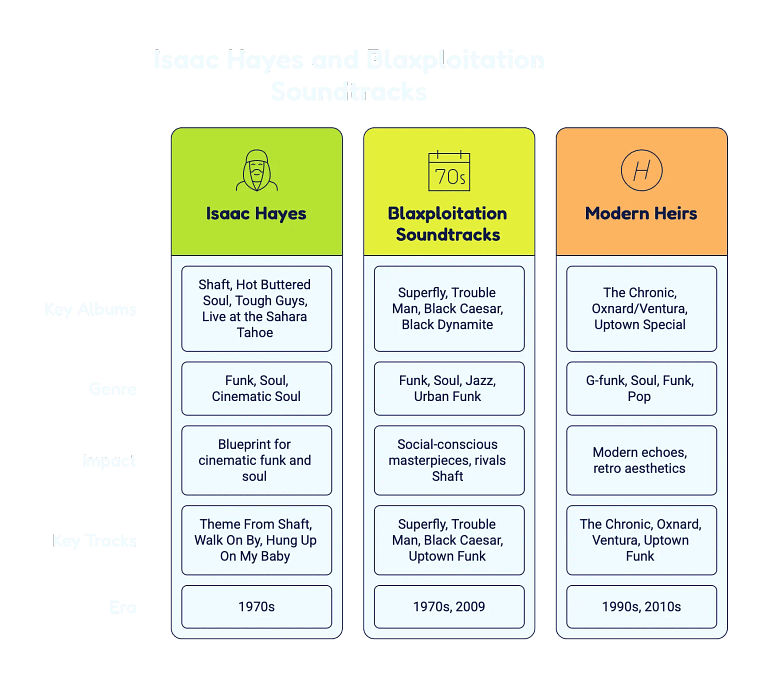
Core Isaac Hayes (Cinematic Soul Essentials)
-
Isaac Hayes – Shaft (Music from the Soundtrack) (1971, Stax/Enterprise): The blueprint; double LP of pure cinematic funk and soul.
-
Isaac Hayes – Hot Buttered Soul (1969, Stax): Long, orchestrated tracks like “Walk On By” that forecast the Shaft sound.
-
Isaac Hayes – Tough Guys (Three Tough Guys) (1974, Stax): More soundtrack work; “Hung Up On My Baby” became a hip‑hop staple.
-
Isaac Hayes – Live at the Sahara Tahoe (1972, Enterprise): Includes a shorter, still devastating live version of the “Theme From Shaft.”
Blaxploitation Soundtrack Cornerstones
-
Curtis Mayfield – Superfly (1972, Curtom): A social‑conscious funk/soul masterpiece that rivals Shaft in impact.
-
Marvin Gaye – Trouble Man (1972, Tamla): Moody, jazzy and experimental, showing how far a soul star could stretch in film scoring.
-
James Brown – Black Caesar (1973, Polydor): The Godfather of Soul leans into dark, urban funk textures.
-
Various – Black Dynamite (Original Motion Picture Soundtrack) (2009, Wax Poetics/Now‑Again): Adrian Younge’s modern tribute, built to sound like 1972 but recorded yesterday.
Modern Heirs and Echoes
-
Dr. Dre – The Chronic (1992, Death Row): G‑funk’s orchestral, cinematic vibe owes plenty to Hayes’ school of production.
-
Anderson .Paak – Oxnard / Ventura (2018/2019): Modern soul/funk albums steeped in 70s texture and storytelling.
-
Mark Ronson – Uptown Special (2015, featuring “Uptown Funk”) (RCA): A mainstream pop dive into retro funk aesthetics.
Essential Playlists – For Your Next Radio Funk Night
Now, let me play curator for you the way I’d program a Radio Funk special.
These playlist concepts are perfect for Mixcloud sets, late‑night listening, or background for your next crate‑digging session.
Playlist 1 – “Cinematic Funk: From Shaft to Superfly”
A deep dive into the golden age of funk soundtracks.
-
Isaac Hayes – “Theme From Shaft” (album version, full intro)
-
Curtis Mayfield – “Freddie’s Dead” (Superfly)
-
Marvin Gaye – “Trouble Man”
-
James Brown – “Down and Out in New York City” (Black Caesar)
-
Isaac Hayes – “Do Your Thing”
-
Isaac Hayes – “Walk From Regio’s”
Playlist 2 – “From Blaxploitation to Boom Bap”
How those soundtracks fed hip‑hop.
-
Isaac Hayes – “Hung Up On My Baby” → Geto Boys – “Mind Playing Tricks on Me”
-
Isaac Hayes – “Walk On By” → Notorious B.I.G. – “Warning”
-
Isaac Hayes – “Theme From Shaft” → Jay‑Z – “Reservoir Dogs” / N.W.A – “100 Miles and Runnin’”
-
Curtis Mayfield – “Give Me Your Love” → Mary J. Blige – “I’m the Only Woman”
Playlist 3 – “Modern Funk Heirs”
For when you want the disco 70s energy with a 21st‑century polish.
-
Mark Ronson feat. Bruno Mars – “Uptown Funk”
-
Anderson .Paak – “Come Down”
-
Adrian Younge – selections from the Black Dynamite soundtrack
-
Tracks from modern Shaft and Superfly remakes with hip‑hop soundtracks, to hear how the DNA was updated.
You can imagine each of these as a Mixcloud set under the Radio Funk banner – a guided tour through funk history, with that Shaft riff as your compass.
Turn Up the Radio, Follow the Riff
It’s funny, isn’t it?
One day, a guitarist in Memphis plugs in a wah‑wah pedal, a drummer locks into a hi‑hat pattern, a singer‑producer with a head full of strings and stories sits at a piano, and suddenly the entire language of film music shifts a few degrees toward funk.
Shaft didn’t just give us a cool detective; it gave us a new way of hearing Black characters on screen – with music that walked, talked and fought alongside them.
From blaxploitation’s heyday to disco 70s, from G‑funk to “Uptown Funk,” and from dusty soundtrack crates to platinum rap albums, the echo of that wah‑wah riff keeps coming back.
Every time a modern producer reaches for cinematic strings over a heavy groove, every time a film uses soul and funk rather than anonymous orchestral wallpaper, a little bit of Isaac Hayes and Skip Pitts is in the room.
And above all, this is why we’re here at Radio Funk. To keep that lineage alive.
To tell these stories. To treat you not like a casual listener, but like family – the kind of person who hears a hi‑hat and a wah‑wah and immediately sees Times Square in 1971.
So here’s your call to action:
After you finish this article, don’t just nod and move on.
Put on the full Shaft soundtrack. Then dive into our Radio Funk specials, our Mixcloud journeys through funk, disco and soul soundtracks.
Let that guitar riff guide you through the city, through the decades, through the deep grooves that changed cinema – and maybe, just a little, change the way you walk down your own street tonight.
Articles similaires


Latest news
Now on air
Upcoming shows
Top Funk
-

1
play_arrowThe Life of the Party
-
2
play_arrowHoney Love
-
3
play_arrowI Can't Help It
-
4
play_arrow(You Were Made) Especially for Me
-
5
play_arrowDancing Machine
-