Auditeurs:
Meilleurs auditeurs :
-
play_arrow
Radio Funk : Webradio Disco, Funk, Soul and Boogie 80
-
 play_arrow
Radio Funk Live Radio Funk

Funk Funeral And Stone‑Cold Resurrection: How “Know How” By Young MC Keeps Disco, Funk And Soul Alive On Radio Funk

In Brief
- A deep dive into Young MC’s “Know How”, a golden‑age rap weapon built on lethal funk and disco samples.
- How Isaac Hayes, Ohio Players and Gary Toms Empire shaped the sound and spirit of this stone‑cold classic.
- Why this track still matters for today’s funk artists, crate‑digging DJs and soul‑obsessed listeners.
- Practical ways to drop “Know How” into your sets, shows and playlists on Radio Funk and beyond.

Drop The Needle, Bury The Boring
Ohhh yeah… welcome, my grieving DJ friends.
You hear that imaginary organ music? That’s not just the funeral of outdated DJs.
That’s the soundtrack of every set where someone forgot the roots: funk, disco and soul.
Today, we’re talking about one of those records that separates the caretakers of groove from the button‑pressing tourists: “Know How” by Young MC.
I’m Mr Radio Funk, your slightly obsessive curator behind Radio Funk, the webradio dedicated to deep disco, raw funk and unapologetic soul.
I’ve spent my life hunched over turntables, stained record sleeves and festival stages, chasing the pulse that ran through the 1970s and 80s dancefloors.
And above all, I’ve learned one thing: the future only sounds good when it respects its past.
“Know How” is a perfect case study. On the surface, it’s a late‑80s rap banger, a showcase of machine‑gun rhymes and West Coast energy.
Underneath, it’s a love letter to Isaac Hayes, Ohio Players, Gary Toms Empire and the whole ecosystem of funk artists who turned grooves into weapons in the 70s.
It’s a track that makes you want to move, to dig, and to never, ever be a lazy DJ again.
So pull up a chair, grab whatever drink goes with your favourite 12‑inch, and let’s take a deep dive into funk history, disco 70s magic and the soul‑heavy DNA of “Know How” – with one clear mission: to help you rediscover the music and listen differently on Radio Funk.
Table Of Contents
- Young MC, Funk And The Golden Age Of Groove
- From Neasden To USC: The Making Of A Pop‑Rap Architect
- “Know How”: Anatomy Of A Stone‑Cold Funk Bomb
- Inside The Samples: Isaac Hayes, Ohio Players And Gary Toms Empire
- Legacy And Modern Impact: From Baby Driver To Nu‑Disco Revivals
- How DJs And Curators Can Use “Know How” On Radio Funk
- FAQ: “Know How” And Funk History
- Recommended Discography
- Essential Playlists For Radio Funk
- Conclusion: Discover The Music, Respect The Groove
Young MC, Funk And The Golden Age Of Groove
The Golden Age Of Funk, Disco And Soul
Before there was Young MC, before there was “Know How,” there was the long shadow of 1970s funk, disco and soul. In 1971, Isaac Hayes records “Theme from Shaft”, a soul‑funk styled movie theme full of wah‑wah guitar, lush strings and street‑level swagger. The track becomes a global hit, climbing to number one on the Billboard Hot 100 and winning both Grammy and Oscar awards – and many consider it one of the first true disco records. That’s not just a chart fact; it’s a cultural signal that cinematic funk and club‑floor disco are fusing into something bigger.
Around the same time, bands like Ohio Players are grinding out horn‑driven sets that ooze sweat, groove and risk.
If you listen to “Skin Tight” or “Fopp,” you hear a group that might not be as polished as Motown or as militant as James Brown, but is absolutely lethal on stage – tight rhythm section, raunchy horns, no room for boredom.
In New York, Gary Toms Empire are dropping infectious jams like “7‑6‑5‑4‑3‑2‑1 (Blow Your Whistle),” selling tens of thousands of copies in a single week and burning up dancefloors with tracks like “Feel That Funky Groove” in 1975.
This is the world “Know How” samples and celebrates: a world where funk artists pushed limits, disco turned nightlife into religion, and soul poured emotion into every bar.
If you’re curating for Radio Funk, this is ground zero – the sacred soil under every modern beat.
Blaxploitation, Soundtracks And Street Cinema
You can’t talk about funk history without talking about cinema.
Blaxploitation films like Shaft brought gritty urban stories to the screen, but it was the soundtracks that really electrified the culture.
Isaac Hayes’ Shaft score, anchored by “Theme from Shaft,” built tension out of hi‑hat shuffles, wah‑wah riffs and orchestral drama, making the music as memorable as the film itself.
The single’s success pushed record labels like Enterprise and Stax deeper into the world of cinematic soul and funk, proving that soundtracks could dominate radio, charts and clubs at the same time.
For DJs, those soundtracks became a treasure trove. They weren’t just songs; they were moods.
You could flip an Isaac Hayes 12‑inch, isolate the intro, and suddenly have a ready‑made tension builder for your disco or soul set.
That mindset – treating records as raw material for new stories – is exactly what producers in the 80s rap era inherited.
When you hear “Know How,” you’re hearing a golden‑age MC borrow cinematic funk vocabulary and translate it into late‑80s swagger, stitching the 70s onto a new rhythmic grid.
From Neasden To USC: The Making Of A Pop‑Rap Architect
Born In England, Raised In Hollis
Let’s talk about the man behind the microphone. Marvin Young, better known as Young MC, is born in Neasden, London, in 1967, before his family moves to Queens, New York, not far from Hollis – the neighbourhood that gave us Run‑DMC.
As a kid, he discovers live rapping in a friend’s basement around 1977, gets hooked instantly, and starts carrying his rhymes in a plastic bag because he can’t remember them all yet. One night, a shootout at a block party forces him to run without his bag; he finds it the next day, but the lesson is permanent: if you want to be a serious MC, you memorize your rhymes and treat performance like survival.
Young’s early influences are a perfect mirror of what we love on Radio Funk. He’s digging through his father’s massive vinyl collection, listening to Chic, KC and the Sunshine Band, Parliament‑Funkadelic, Fleetwood Mac, Bob Marley, The Eagles, Kool & The Gang and more.
He’s rapping over “Good Times,” “Bounce, Rock, Skate, Roll,” the original “Walk This Way” and Billy Squier’s “Big Beat,” building a comfort zone where rock, funk, disco and pop all coexist as potential backing tracks.
That wide‑angle taste is crucial: it explains why his later music feels accessible, pop‑leaning, but still firmly rooted in groove.
Delicious Vinyl, Bust A Move And Stone Cold Rhymin’
Fast‑forward to 1987: Young is in his third year studying economics at the University of Southern California (USC) when he’s introduced to Mike Ross of Delicious Vinyl. He raps down the phone for Ross and Matt Dike, dropping lines that will later appear in “I Let ’Em Know” and “My Name Is Young,” and within a week the founders show up at his dorm room with a recording contract. It’s the classic late‑80s fairy tale: small label, hungry talent, no guarantee – just pure belief in the power of words over breakbeats.
Delicious Vinyl first releases Young MC as a solo artist, but his pen quickly becomes legendary. He co‑writes lyrics for Tone‑Loc’s massive hits “Wild Thing” and “Funky Cold Medina,” helping both tracks break the Top 10 on the Billboard Hot 100 and proving that rap can be humorous, radio‑friendly and still credible. In 1989, he drops his own signature single, “Bust A Move,” which earns him a Grammy for Best Rap Performance and pushes his debut album Stone Cold Rhymin’ into platinum territory. That album, often praised as a benchmark of pop‑rap, includes “Know How,” tucked in among radio hits and school‑yard stories.
Here’s the key point: Young MC is not a boom‑bap purist. He’s a bridge‑builder. He writes rhymes that can sit comfortably next to disco, funk and pop hooks, which is exactly why “Know How” works so beautifully as a tribute to the 70s while still punching like a late‑80s rap track.
“Know How”: Anatomy Of A Stone‑Cold Funk Bomb
The Track, The Album, The Label
“Know How” appears on Stone Cold Rhymin’, released in 1989 on Delicious Vinyl, the same label that carried Tone‑Loc and later acts like The Pharcyde and The Brand New Heavies.
The track sits alongside “Bust A Move,” “Principal’s Office” and other cuts, but for many crate‑diggers it’s the secret weapon: less overplayed, more rhythmically intense, and built like a DJ tool disguised as a single.
Critics and fans have pointed out how “Know How” leans heavily on the “Theme from Shaft” sample, making it instantly recognisable and giving it a cinematic funk edge.
The combination of dense rhyme schemes – “some of the busiest rhymes ever made by man” in spirit, without quoting the lyrics – and tight sampling turned it into a cult favourite among those who bought Stone Cold Rhymin’ on vinyl and wore their copies out in the early 90s.
Here’s a compact look at the essentials:
Key Info Table – “Know How” By Young MC
| Item | Detail |
| Track Title | “Know How” |
| Artist | Young MC (Marvin Young) |
| Album | Stone Cold Rhymin’ |
| Year Of Release | 1989 (album release) |
| Label | Delicious Vinyl[45][35] |
| Primary Genres | Pop‑rap, funk, soul, disco‑influenced |
| Notable Samples | “Theme from Shaft,” “Apache,” “Fopp,” “Skin Tight,” “Feel That Funky Groove,” “7‑6‑5‑4‑3‑2‑1 (Blow Your Whistle)” |
| Cultural Resurgence | Featured in Baby Driver soundtrack selections and DJ culture discussions. |
Let’s be blunt: “Know How by Young MC” is one of those tracks that belongs in every serious funk history article, every disco 70s playlist and every soul‑aware DJ’s toolbox. It’s textbook Radio Funk material.
The Art Of Sampling The Funk
Now, today we’re talking about one of the deepest pleasures in DJ life: hearing how a producer chops funk and disco classics into something new. “Know How” is a masterclass in this.
The production layers several key 1970s tracks, using drum breaks, bass lines and riffs as the skeleton of Young MC’s flows. The result feels both familiar and fresh: you recognise the grooves subconsciously, but the structure is pure golden‑age rap.
The track pulls drums from “Apache” by Incredible Bongo Band,” a 1973 tune famous for its breakbeats and long beloved by hip‑hop DJs.
It borrows bass and groove elements from Ohio Players’ “Fopp” and “Skin Tight,” bringing horn‑band intensity into the mix. It lifts riffs from Gary Toms Empire’s “Feel That Funky Groove” and hooks from “7‑6‑5‑4‑3‑2‑1 (Blow Your Whistle),” both cornerstones of mid‑70s disco‑funk that once sold huge numbers in New York.
And above all, it rides the iconic guitar and orchestral textures of “Theme from Shaft” by Isaac Hayes,” reminding every listener of the movie hero who walked so our DJs could strut.
For a DJ, that means “Know How” isn’t just a song. It’s a sampler platter of classic funk artists and disco grooves, condensed into four minutes of narrative rap. When you play it, you’re not just dropping a track – you’re quoting an entire era.
Inside The Samples: Isaac Hayes, Ohio Players And Gary Toms Empire
Isaac Hayes – The Shadow Of Shaft In “Know How”
Let’s start with the big one. Isaac Hayes’ “Theme from Shaft” was released in 1971 on the Enterprise imprint of Stax Records, and built around a distinctive wah‑wah guitar riff, hi‑hat shuffle and lush orchestral arrangement.
The single not only topped the Billboard Hot 100, it also won an Oscar for Best Original Song and multiple Grammys, and is widely regarded as one of the earliest disco‑leaning funk records.
When Young MC and his producers drag “Theme from Shaft” into “Know How,” they’re not just stealing a cool riff. They’re pulling in a whole cinematic universe: private detectives, smoky streets, dangerous romance and 70s Black cool.
The guitar lines and mood from Hayes turn “Know How” into something more than a braggadocious rap track – they make it feel like a chase scene, a night walk, a piece of street theatre.
For listeners tuned into soul and funk, that sample acts like a secret handshake: you either recognise it and smile, or you go dig for the original and fall in love with an entire catalogue.
Ohio Players – Horn‑Driven Heat And Street Funk
Then come the Ohio Players, a band that made their name in the 70s with horn‑heavy, gritty funk that lacked the polish of Motown but more than compensated with energy.
Tracks like “Skin Tight” (1974) and “Fopp” (1975) are pure stage burners: bass lines that never quit, brass stabs that feel like punches, and grooves made to be played loud in packed rooms.
A live recording from 1977 captures them opening with “Love Rollercoaster” and closing with an extended “Fire,” showing a band at its commercial peak and funkiest form.
In “Know How,” those Ohio Players elements become part of the rhythmic backbone.
Bass fragments and patterns are looped and tightened, giving Young MC a rolling, muscular foundation on which to spit his verses.
For DJs, the message is simple: if you love how “Know How” feels in the low end, go and get those Ohio Players records. They’re the source code.
Gary Toms Empire – Whistles, Grooves And Disco Floor Burners
Finally, we reach one of the lesser‑known pillars: Gary Toms Empire.
Their track “7‑6‑5‑4‑3‑2‑1 (Blow Your Whistle)” becomes a local phenomenon in New York in 1975, selling over 40,000 copies in a single week and landing on countless compilations and DJ playlists.
The group follows it with cuts like “Slow & Funky” and “Feel That Funky Groove,” both strong disco floor‑burners that never quite match the commercial impact of “Blow Your Whistle” but remain cult favourites for selectors.
“Know How” samples both the whistle‑driven hook of “7‑6‑5‑4‑3‑2‑1 (Blow Your Whistle)” and the riff from “Feel That Funky Groove,” folding them into its beat to add sparkle, movement and mid‑range melody.
For a modern listener, that gives the track an almost playful, carnival‑like energy; for a DJ, it’s a usable reminder that one‑hit‑wonder funk artists often leave behind some of the best dancefloor material. The big single isn’t always the only treasure.
Legacy And Modern Impact: From Baby Driver To Nu‑Disco Revivals
Baby Driver, Ads And Cultural Resurfacing
Decades after its release, “Know How” keeps resurfacing. It appears among tracks associated with the film Baby Driver, a soundtrack praised for its clever use of vintage songs in high‑speed heist scenes.
This kind of placement matters: it introduces the tune to younger audiences who may never have bought Stone Cold Rhymin’ on vinyl, but suddenly want to Shazam every drum hit on their cinema seat.
The track also pops up in discussions around advertising, with fans noting its use in a McDonald’s campaign and reacting to the way corporate brands mine late‑80s pop‑rap to sell nostalgia.
Whether you love or hate that, it proves one thing: funk, disco and soul‑rooted samples still carry emotional weight strong enough to sell cars, burgers or streaming subscriptions.
For Radio Funk, the takeaway is simple – these records are far from dead. They’re everywhere, often hiding in plain sight, waiting for a proper musical context rather than a jingle.
Modern Artists Carrying The Funk Torch
If you think the funk artists chapter closed in 1985, you haven’t been paying attention. Today’s scene is packed with acts who clearly owe a debt to 70s disco, funk and soul.
A GRAMMY.com guide to modern funk and nu‑disco highlights groups like L’Impératrice, Shiro Schwarz, Franc Moody, Say She She and Moniquea, all committed to bringing live bass, synth‑heavy grooves and vocal warmth back to the dancefloor.
Their records may be new, but the skeleton is classic: strong bass, tight drums, melodic hooks – exactly what we celebrate on Radio Funk.
On the pop side, you’ve got tracks like “Uptown Funk” by Mark Ronson featuring Bruno Mars, officially released as a single in 2014 and built as a deliberate homage to 1980s Minneapolis funk and classic American soul.
Ronson has described the track’s origins in a “straight funk disco” jam session, and critics have noted how it draws from James Brown, Prince and other giants of groove.
The song went on to win major Grammy awards and dominate global charts, showing that funk‑scented, horn‑driven pop can still rule the airwaves when done right.
For us at Radio Funk, that’s both a warning and an invitation.
The warning: if you’re not respecting the roots, the mainstream will happily cherry‑pick them and sell them back to your audience.
The invitation: if you know how to connect Young MC, Isaac Hayes and modern nu‑disco, you can curate sets and shows that feel timeless instead of nostalgic.
How DJs And Curators Can Use “Know How” On Radio Funk
In The Mix: Practical Tips For Selectors
Today, we’re talking about the difference between playing a track and playing a story. “Know How” gives you the story for free – you just have to sequence it right. As a DJ, selector or curator for Radio Funk, you can treat the track as a hinge between eras.
A few practical ways to work it:
- Open a funk history show with “Theme from Shaft”, move into Ohio Players, sprinkle Gary Toms Empire, then slam into “Know How” as your bridge from 1970s disco/funk to late‑80s rap.[36][37][40][30]
- Use “Know How” as a mid‑set energy spike in a golden‑age hip‑hop mix, especially if you’re blending around 100–110 BPM funk‑based tracks and want something that feels both classic and less overplayed than “Bust A Move.”
- For vinyl collectors, showcase the 12‑inch in a segment about sample culture, cueing the original records one by one and letting listeners hear how those riffs and breaks were transformed.[50][33][30]
The goal is simple: make people feel the disco 70s and soul history inside the record, not just the nostalgia of their first cassette.
You’re not a jukebox. You’re a storyteller with grooves.
Essential Playlists For Radio Funk
To help you structure your next shows or personal listening sessions, here are some Essential Playlist concepts tailored to Radio Funk.
These aren’t rigid tracklists – they’re frameworks you can adapt, whether you’re on Mixcloud, a live stream or the radio schedule.
- From Shaft To Know How
A journey from Isaac Hayes’ cinematic soul/funk to Young MC’s sample‑based pop‑rap. Think soundtracks, horn‑bands, then golden‑age MCs. - Ohio Players And The Funk Architects
Focus on horn‑driven 70s funk artists whose grooves later appeared in hip‑hop. Build around Ohio Players, add related bands, then close with “Know How” as a subtle nod. - Blow Your Whistle: Disco Floor Burners
Start with Gary Toms Empire’s “7‑6‑5‑4‑3‑2‑1 (Blow Your Whistle)” and “Feel That Funky Groove,” then widen out to mid‑70s one‑hit wonders, ending on “Know How” to show how those “minor” hits became major sample sources.
Curate these sets on Mixcloud, reference them on air, and keep telling the story: funk, disco and soul didn’t vanish; they evolved through records like “Know How” and now live permanently in the DNA of Radio Funk.
FAQ: “Know How” And Funk History
Why is “Know How” important in funk and disco history?
Because “Know How” is a late‑80s rap track built almost entirely on 1970s funk, disco and soul samples, it acts as a bridge between eras. By drawing from Isaac Hayes, Ohio Players and Gary Toms Empire, it preserves the feel of those original grooves while presenting them in a new narrative form. For students of funk history, it’s a textbook example of how hip‑hop re‑energised vintage records and brought them back to dancefloors.
Which samples define the sound of “Know How”?
Key samples include “Theme from Shaft” by Isaac Hayes, providing the cinematic funk backbone; “Apache” by Incredible Bongo Band, contributing iconic drum breaks; Ohio Players’ “Fopp” and “Skin Tight”, adding bass and horn power; and Gary Toms Empire’s “Feel That Funky Groove” plus “7‑6‑5‑4‑3‑2‑1 (Blow Your Whistle),” which inject hook lines and disco flavour. Together, they create a layered, sample‑rich beat that feels like a mini‑history of 70s groove.
How did Young MC’s background influence “Know How”?
Young MC grew up between London and Queens, absorbing rock, funk, disco and reggae from his father’s vinyl collection and his DJ friends. He rapped over tracks ranging from “Good Times” to “Bounce, Rock, Skate, Roll,” which gave him a natural ease in combining rap with crossover grooves. Later, his work at USC and signing with Delicious Vinyl placed him in a pop‑rap context, where accessibility matters – that’s why “Know How” feels both deeply rooted in soul/funk and immediately enjoyable to casual listeners.
Is “Know How” more than just a rap track?
Yes. It’s also a curated collage of 70s records and a living archive of sample culture. When you play it, you’re referencing Isaac Hayes’ film soundtrack successes, Ohio Players’ touring power, and Gary Toms Empire’s short‑lived but impactful disco career. For DJs, it’s a reminder that every “simple” beat can hide a complex network of musical history.
How does “Know How” connect to today’s funk and disco revival?
Modern acts like L’Impératrice, Franc Moody and Say She She, as well as mainstream hits like “Uptown Funk,” draw heavily on 70s funk, disco and soul aesthetics – horns, bass lines, call‑and‑response vocals. “Know How” shows the earlier stage of that revival: late‑80s hip‑hop already re‑framed those grooves for new audiences. Understanding it helps you see today’s nu‑disco and funk revival not as a trend, but as the latest chapter in a long conversation.
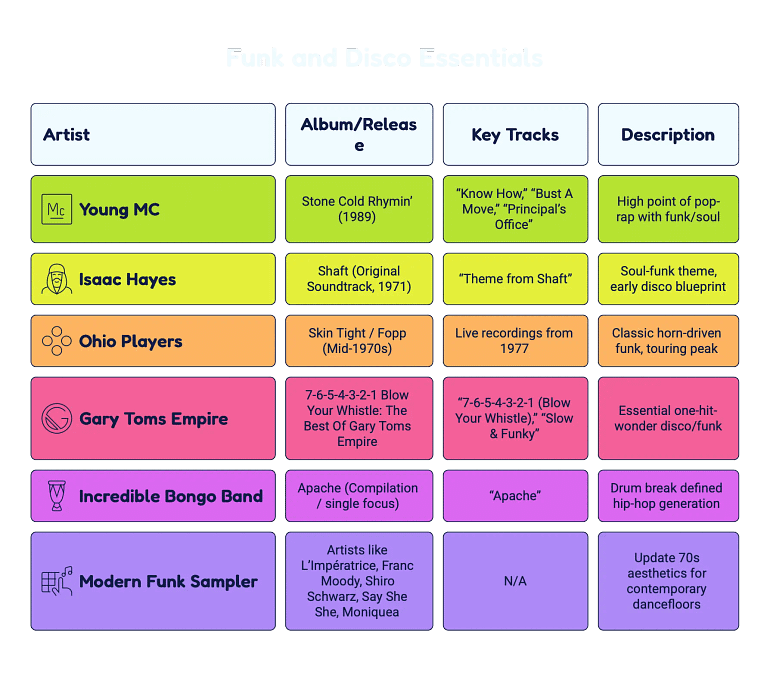
Recommended Discography
To deepen your connection to “Know How” and the world it samples, here’s a concise discography path – perfect for Radio Funk specials, Mixcloud deep dives or weekend listening.
- Young MC – Stone Cold Rhymin’ (1989, Delicious Vinyl)
The album that contains “Know How,” “Bust A Move” and “Principal’s Office,” representing a high point of pop‑rap with strong funk and soul underpinnings. - Isaac Hayes – Shaft (Original Soundtrack, 1971)
Includes “Theme from Shaft,” the soul‑funk theme that won Oscars and Grammys and is widely seen as an early disco blueprint. - Ohio Players – Skin Tight / Fopp (Mid‑1970s releases)
Classic horn‑driven funk; live recordings from 1977 show the band at their touring peak, exuding relentless groove. - Gary Toms Empire – 7‑6‑5‑4‑3‑2‑1 Blow Your Whistle: The Best Of Gary Toms Empire
Compilation including “7‑6‑5‑4‑3‑2‑1 (Blow Your Whistle),” “Slow & Funky” and “Feel That Funky Groove,” essential one‑hit‑wonder disco/funk. - Incredible Bongo Band – Apache (Compilation / single focus)
The track whose drum break defined a generation of hip‑hop and remains a sample‑crate staple. - Modern Funk Sampler – Artists like L’Impératrice, Franc Moody, Shiro Schwarz, Say She She, Moniquea
As highlighted in GRAMMY.com’s modern funk guide, these acts update 70s aesthetics for contemporary dancefloors.
Essential Playlists For Radio Funk
To really embed “Know How” in the DNA of Radio Funk, structure your content around strong, narrative playlists. Here are a few ready‑to‑use concepts:
- Stone Cold Funk Bridges
- Isaac Hayes – “Theme from Shaft”
- Ohio Players – “Skin Tight”
- Gary Toms Empire – “Feel That Funky Groove”
- Young MC – “Know How”
Build outward from these four pillars, adding complementary funk and disco cuts that share tempo and mood.
- Delicious Vinyl Story
-
- Tone‑Loc – “Wild Thing”
- Tone‑Loc – “Funky Cold Medina”
- Young MC – “Bust A Move”
- Young MC – “Know How”
- The Pharcyde – add a cut from their Delicious Vinyl era
Use this to explain how one indie label helped shape pop‑rap and left a mark on funk‑rooted samples.
- Funk’s Global Impact: From Shaft To Uptown Funk
-
- Isaac Hayes – “Theme from Shaft”
- Ohio Players – “Fire” or “Love Rollercoaster”
- Young MC – “Know How”
- Mark Ronson feat. Bruno Mars – “Uptown Funk”
Close the circle, showing how 70s funk and disco aesthetics keep returning in modern global hits.
Mention these playlist concepts on air, reference them on your site, and push them to Mixcloud with strong descriptions focusing on funk, disco, soul and Radio Funk as key terms.
Discover The Music, Respect The Groove
It’s simple. Outdated DJs die when they stop learning, when they treat classics like museum pieces instead of living tools. “Know How” by Young MC is proof that the line between past and present is razor‑thin and endlessly reusable. It stands on the shoulders of Isaac Hayes, Ohio Players and Gary Toms Empire, turning their 1970s funk, disco and soul into late‑80s pop‑rap fire. It whispers something to every selector, every crate‑digger, every listener with impeccable taste: if you know how to dig, you know how to play.
As the greatest disco‑funk‑soul DJ in this little corner of the universe, my vow is simple: on Radio Funk, we don’t just spin records. We tell stories. We bury boring sets and resurrect the groove with care, history and passion. We’ll keep connecting tracks like “Know How” to their ancestral lines, curating nights, shows and playlists that make you dance, think and feel at the same time.
Go discover the music. Hunt down the original funk artists, listen to disco 70s soundtracks, dig into the soul behind every sample. Tune in to Radio Funk, follow our mixes on Mixcloud, and let “Know How” remind you – and your audiences – that the groove never dies when you treat it like a living, breathing legacy.
Stream now on Apple podcast, subscribe to Radio Funk Lab on YouTube, and if you’re really stuck in the Stone Age, visit our human DJs on Mixcloud & Twitch
Final warning: After this, your excuses won’t age like wine they’ll just curdle.
Articles similaires


Latest news
Now on air
Upcoming shows
Top Funk
-

1
play_arrowThe Life of the Party
-
2
play_arrowHoney Love
-
3
play_arrowI Can't Help It
-
4
play_arrow(You Were Made) Especially for Me
-
5
play_arrowDancing Machine
-